Writing-with, thinking-with, working-with speculation – a conversation

Henna-Riikka Halonen & Aino-Kaisa Koistinen

A videowork by Henna-Riikka Halonen.

A porous autopoietic entity, a response, first draft

huminaa
ääni yhtyy linja-auton meluun
mikä virhearvio kuunnella tätä täällä
mutta sittenkin jotenkin sopiva keinutus, liike, matka
First image: organs disconnected
something reminds me of Monty Python
we are inside something
and there is something moving
sound, a cluck, like chicken
the noise of the bus and other passengers
clouding what I hear
drawing my attention
shapeshifters
something flowing in
a voice addressing me
this is us, this is me
this what flows
the networks of cells like
nebulas
a cell like planet
is it a cell or something else?
a porcupine
a photon
see-through
i am not
a natural scientist
another image: landscapes of flesh
within me within us within we
fantasy worlds
maa-alueita ja mannerlaattoja
valkoisia, kelluvia
then a forest of kelp
but inside you
then mushrooms growing
i should now more
about us, living bodies
concepts to name things with
what to call these mushrooms with?
näitä lehvästöjä
ja sitten, leikkaus avaruuteen
ja sitten, vedenalaiseen fantasiaan
onko tämä kaikki minussa
vai kuvittelua?
ja mitä väliä on ymmärtämisellä
something is moving
on the screen, within me, us
we are watching
together
writing
together
breathing
words
beauty and disgust tied into together
is this what I am?
ymmärtää ilman sanoja ymmärtää
miten rajallinen määritelmä
suddenly there is music
a syringe
little spiders
an ear
on a blob
I am reminded of the ear
on the back of the mouse
a monstrosity
this is about networks
networks
in the space
place
that we all are
chords tying together, tellings
of blood
why write these words
and not others
why this chain
a vampire?
do I really contain this beauty?
do
I
contain
can it be said? – or am I leaking, boundless…
of the world, from the world
kuva: ruskea silmä, minun silmäni, peili
yhtäkkiä jostain muistuu mieleen
minä pienenä tyttönä
itkemässä äidille
ettei naistenlehdissä näy kuin sinisiä silmiä
miksi minun silmäni tällaiset, tällaiset
ja tässä nyt, ihmisyyttä edustava ruskea silmä
ja silti, mikä etuoikeus, etuoikeudet
valkoisuus, keskiluokkaisuus, muun muassa
sen opin vasta myöhemmin
ja sitten –
we, companion species –
koirallanikin on ruskeat silmät
oli ruskeat silmät
entanglements
Harawayian kindred spirits
tuntea yhteys koiraan
ja sitten
liike, liikun linja-auton mukana, tässä,
tämä sommittuma, tuntuma, tu tu tun tun tu ma ma
kuulokkeet päässä
mutta mikä minä? but which I?
we are companion species
– resistance is futile –
who is we? how many wes do I contain?
the notes filling me
until they fade
the story
that is not a story
ends
continues within
I, us, we
companion species

A videowork by Henna-Riikka Halonen.

Aino-Kaisa: This is the second time that I have written a response to a video work (see here). This time, however, I am not only responding to a video, but we are crafting a dialogue – between our works, artistic practices, and us, a poet and a visual artist. What can we give each other, responding to each other this way? For me, writing with your artwork (or, as I like to spell it, “writing-with”) created a certain flow, an enjoyable stream of consciousness, the video inviting words and experiences, suggesting a rhythm for writing. Yet the associations, of course, also stem from my background as a scholar reading Donna J. Haraway’s work (e.g. Companion Species Manifesto), and my embodied experiences and memories (such as my history of watching Star Trek). When writing, I avoided pausing the video, and any thoughts and experiences needed to be quickly transmitted to words. No room for hesitation, editing, perfectionism. Nor stop to think, why I had just changed language.

Afterwards, I edited the text slightly to let the text itself suggest amendments to its poetics. Did this experiment produce something that I might call an artwork, or poetry, or speculation? Perhaps the text does not need to stand alone as (a speculative) work of art but emerges as such through this dialogue – or, the video and this dialogue give an interpretive framework, a context, for the text. Now I would like to throw the ball to you, Henna-Riikka: This method seems to have created some space for me to write. But does my writing create a space for you? What kind of space?

Henna-Riikka: Since quite a while I have been thinking about how visual and spatial practice can come together with literature in a meaningful way. What can we, artists and writers, give to each other? I think my goal in my artistic practice and also as a researcher has been to resist summary, to make something that cannot be explained in words, although as a video artist text is an inherent part of my works of course. But I also think a text that responds to an artwork that already exists can have a life of its own, without the work, similarly as the work has a life of its own. They meet momentarily and even entangle, but keep developing their own logic. I think poetry and visual art function in a broad sense, in a similar manner. Writing is not in itself worse or better than drawing, for example. You can write in many different ways, just as you can draw. I think the challenge concerns the design and construction of the whole exposition, the way in which the different parts, stages, makers and audiences are interlinked. You also talked about flow and rhythm and I think this is a way to go, allowing yourself as maker and reader of the work to follow them.

I think in this way the associative poetic way you responded to the video work can be very fascinating. And as we can see, the text then becomes a lot more about how you experience, sense and remember the world but at the same time creates new access points, underlining the porosity of the work. Interestingly in the first reading, I didn’t notice that part of your text was in Finnish. I guess that was because here the language becomes something else than the carrier of the message and appears more like a material or perhaps as a texture.

Aino-Kaisa: Your videos above make use of science fiction and fantasy imaginaries, and the technique of estrangement. More specifically, they make the familiar, in this case the human body, somehow strange (I simply adore the talking nose!). I have always been drawn by the power of speculation in fiction/art. Drawing, again, on Donna J. Haraway’s work, what kinds of worlds – or, indeed, worldings – are we making with our imaginations? Writing-with your work Tissue enabled me, in a way, to step into a speculative world and associatively continue and expand it; although the text itself ended up not so much crafting a speculative world or environment of its own but chasing a personal, embodied train of thought inspired by your speculation. How do you see the role of speculation in your work?

Henna-Riikka: I am interested in using the means of speculative fiction literature that can break the boundaries of human-centered thinking by bringing non-human actors, models, systems, and temporalities to the fore. Alongside artistic methods, it can bring together differently situated, porous bodies through retelling and rewriting. I think speculative fiction offers new temporalities and imaginative leaps. One of the ways to do this is through thought experiments, asking questions such as, what if, as if?

For me, a literary text itself is a kind of prosthesis and allows these playful thought experiments and new kinds of temporalities that we cannot quite recognize, but can see some familiar strangeness in them.

The video Tissue started with a simple thought experiment; what if human bodies as we know them didn’t exist but instead organs and tissue would be grown in prosthetic factories. The talking nose is sort of a main protagonist and this quite obviously was inspired by a great literary classic The Nose by Nikolai Gogol. But unlike in Gogol’s novel, where the nose enjoys freedom in a wide world after detaching from the face, here the nose remains connected to the prosthetic world. Access to another world is only achieved by turning inwards, through the nostril, skin, tissue and the nervous system. This realm reveals a fantastical multispecies world created from a modified scientific 3D model of a human cell.

However, while discussing speculation as an artistic strategy, I think we must remain critical of its free use. Although speculation can be productive, it isn’t always beneficial. Capitalist systems also use speculation as a form of oppression, so we need to carefully consider whose dreams we are dreaming.

About the authors:

Henna-Riikka Halonen is a visual artist/researcher who has worked on and produced many collaborative and large-scale projects and and has shown her work widely in international exhibitions. Currently she is working as a Visiting researcher at the Academy of Fine Arts, Uniarts Helsinki and as a Senior Lecturer of Contemporary Art in Turku Art Academy, Finland. www.hennahalonen.com

Aino-Kaisa Koistinen is a scholar, a poet, a writer, and teacher of creative writing. She/they currently work as University researcher at the University of the Arts Helsinki Research Institute in the profiling area Artistic thinking that is driven by artist pedagogy (funded by the Academy of Finland 353305).
Monster Talks transcribed – and a Halloween treat!

In the recent years, The Monster Network has taken up measures to make our activities more accessible. We are therefore happy to let you know that all of our Monster Talks podcasts are now transcribed! The transcriptions can be found here.

And that’s not all! As you might now, The Monster Network has a tradition of hosting/publishing a Halloween special, and there might be something special coming your way this Halloween, too. Stay tuned!

Think/Feel/Repeat: Writing-with the Memory Space Traveler

what do machines dream of
if not electric sheep
a remembrance
in the shape of
a butterfly, a tree
neurons turning
into trees
trees into waves
so many
waves
whales
singing
a mirage
medusas into mountain tops
into a Japanese painting
of waves
such waves
into neurons
neurons into
a mirage
a
a
a
bird, swan, cloud
a nebula
a universe
a verse
a
a
a
lightning strike
so bright
a network
I remember
the hurt
but this is not how it went
at all
waves into
neurons into
spider webs into
a haunted house into
a sunken ship
a treasure
a moth
a
a
a
ripple
of snow
mist forest fungi
lungs breathing broken
glass
a fragment
a mirage
a flicker
a
a
a
neuron
a star
a bone
a forest
with roots
of smoke
a nebula
a stream
birds like sparkly
space-things
butterflies
of the eternal
a swan
an angel
an alien
a universe, a verse
this is how I remember
a mirage
in mid-july
a
a
a
medusa
a ghost
a compost
mushrooms
pushing up from the ground
life
stubborn
life
remembered, forgotten
ancient, anew
but this is not how
it is going to
a glitch in the machine
a ghost ship
a tipping point
in time
be remembered
a mirage
a shape-shifter
a
a
a
does it matter
what is real
we are all
sleepwalkers
through time
you
and
i
monsters
in mid-july

.

.

.

Outro

In November and December 2022, I spent some time as a visiting scholar at the University of Stavanger (UiS), Norway, where I worked in the project Caring Futures: Developing Care Ethics for Technology-Mediated Care Practices. As part of my work, I got to experience the Caring Futures art exhibition, that is connected to the research project, at Sølvberget galleri, Stavanger, Norway.

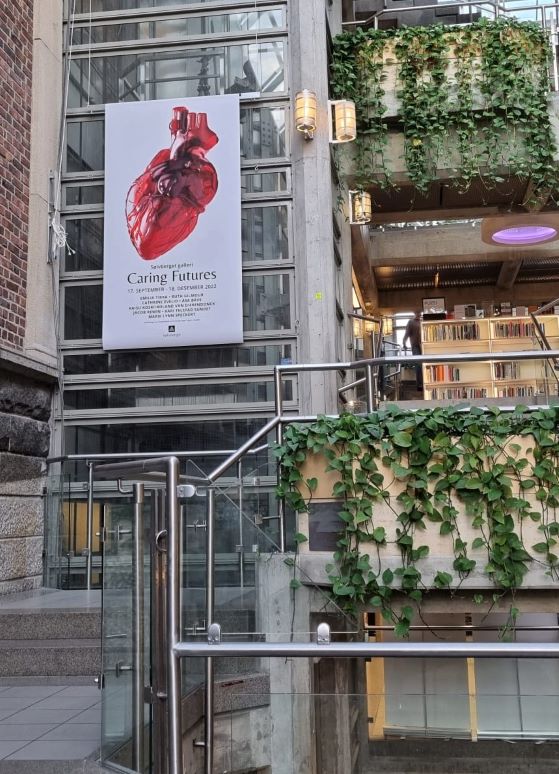
Image: The stairways leading to the exhibition space at Sølvberget galleri. There is a poster of the exhibition showcasing a red, artificial heart, and green wines hanging in the staircase. Photo taken by Aino-Kaisa Koistinen.

The Caring Futures exhibition asks questions such as ”what is at stake when technological innovations are presented as solutions to new demands in contemporary care and welfare. Are questions about ethics, trust, and compassion left behind in the rapid development and implementation of new technologies?” Read more here.

The exhibition is put together by Monster Network’s Ingvil Hellstrand, Associate Professor at the Department of Caring and Ethics, UiS, who currently works in the Caring Futures project, and artist/curator/PhD-candidate Hege Tapio, who runs i/o/lab: Centre for Future Art and works at OsloMet.

For me, exhibition raised questions of the limits of care, affects, movements and connections, memory, boundaries, and the connections of care and violence. The exhibition is open until 18 December 2022 – so there is still time to experience the exhibition for yourself! I fell in love especially with Kari Telstad Sundet’s audiovisual installation ”Memory Space Traveler”, a work that, according to the exhibition catalogue, ”tries to look at mechanomorphism and anthropomorphism from a different angle – literally through the dreams of a semi-sentient machine”.

The above text – a poem, a seance, a meditation? – is a slightly edited stream of consciousness written while thinking- and feeling-with the video installation. The typography of the text was created partly as a surprise; a glitch in WordPress that removed all the empty lines from the text. This glitch perhaps made the text more true to the process of its creation, a stream of consciousness moving with the video installation, ideas and associations constantly changing and evolving.

Aino-Kaisa Koistinen

Withdrawing our panel from the NORA Conference 2022

The Monster Network was accepted for a session at the NORA conference this year with an abstract called “Feminist Monster Studies”. However, as part of our ongoing work in the network on accessibility and inclusion, we have decided to withdraw our session. You can read our letter to the organisers below.

Dear organisers,

We regret to inform you that we are withdrawing our panel on Feminist Monster Studies for the NORA Conference 2022 “Tensions and Potentials in Nordic Feminist and Gender Research”.

Our decision to withdraw is grounded in the following points:

Our panel proposal revisits feminist, queer and decolonial critiques of othering and the making-monstrous of marginalised bodies, voices and knowledges (full abstract below). It is therefore a paradox for us that the framework for this conference, as an in-person conference, prohibits certain bodies from attending. Although the pandemic restrictions in Norway, and the Nordic countries more generally, are in the process of being revoked at this moment of writing, the conditions for living in a pandemic vary greatly according to which country you live in, your health and vaccination status, as well as the possibilities for and risks of travelling.

Although we understand the desire to meet in person and appreciate that the organisers need to make logistical choices, there seems to be little concern for or attention to the potential need for doing the conference otherwise. Part of our aim with the work on feminist monster studies is precisely to stress how the “otherwise” in the histories of feminist and queer lives is at odds with what is considered “established frameworks”. This is indeed what makes certain bodies and voices monstrous, but also what catalyses change and recognition. It is regrettable that the organisers – in the invitation to attend the conference – have not seen fit to acknowledge this need, which the fields of feminist, queer and disability studies have shown to be lifesaving.

We wanted to discuss borders and boundaries for what is considered acceptable and unstable or disregarded, unofficial/unrecognised and official/recognised. Given the conference invitation, we think and feel that such a discussion is not possible other than as a theoretical or abstract point. Pre-pandemic, the need for action and systemic change had been voiced in particular from the fields of crip theory, disability studies, queer theory and feminist studies. In our current global pandemic context, it is impossible not to listen to these calls for systemic change, accessible spaces and non-deadly ways of being collectively. Such crip, queer and decolonial perspectives must be actively taken into consideration, perhaps especially so from a feminist conference. 

Our goal was to critically and personally reflect on collaboration and collectivity across differences and divergencies. It is therefore with both sadness and frustration that we have come to the decision that we will not attend the conference with this collective monster panel. We did consider suggesting a possible hybrid solution, but part of the problem is that it should not be an afterthought for the organisers. That said, everybody can learn and rethink previous choices, and that might be an argument to change this decision. However, we want to make our work as accessible as possible, even if we sometimes fail to do so, and at least try to put into practice a politics of being and doing collectively that does not exclude or hinder the health and well-being of those who wish to participate. This is a work in progress for the Monster Network and one way in which we do this is by refusing to take part in exclusionary, inaccessible and potentially deadly events, particularly during a pandemic. We will continue to think about feminist monster studies otherwise.

Regards,

The Monster Network

(Ingvil Hellstrand, Aino-Kaisa Koistinen, Donna McCormack & Sara E.S Orning)

Abstract:

Feminist monster studies

Marginalised bodies, voices and knowledges are often relegated to the realm of the monstrous, in the sense that they are deemed ‘abnormal’, untruthful, or unreliable. In this panel, we revisit the ways in which monsters and the monstrous long have been of interest to feminist, queer and decolonial thinkers. Importantly, this is not to “show” what is construed as monstrous, but to demonstrate how thinking-with the monster can serve as a feminist method to grapple with and challenge structures of differentiation, and boundary-making categories of belonging. What kinds of monstrous imaginaries are at stake in the debates in and about gender studies? To what extent does the threat of the monstrous reimagine debates about knowledge production, agency and belonging, both outside and inside the field of feminist and gender studies? And what is at risk when even articulating an inside and an outside of any field? 

In this panel, we introduce feminist monster studies as a thinking tool for exploring tensions between what is considered acceptable and unstable or disregarded, unofficial/unrecognised and official/recognised, knowledges and bodies. Although the monster can certainly be unsettling, our aim is to spawn a discussion about boundaries, belonging and marginalisation in Nordic feminist and gender research, and develop strategies for how to reimagine collaboration and collectivity across differences and divergencies. 

Green Ink: Monster Plants in Sinophone Fiction

By Astrid Møller-Olsen

A monster plant is a sinister thing, it thwarts knowledge and reverses the rules – you don’t eat it, it eats you; despite its roots, it moves about. A monster plant is monstrous because it behaves like a human; in it, we see the worst sides of ourselves: our greed, lust, violence. Or so it used to be…

But in our age of human-made climate change and environmental unpredictability, the so-called Anthropocene, plants have morphed from the radical (pun intended) ‘Other’ who can destroy us, to the one who might save us. Significant botanical others are not confined to the pages of Nature writing – vegetal characters are not only a subject for science fiction but walk abroad in a variety of literary contexts.

What can we learn from these unruly creatures? Can being curios about what it means to be a plant help us understand what being human might come to mean in the future? (Already there is an imbalance in this question – estimates calculate that this planet is home to nearly 400.000 plant species – clearly, being a plant is a lot of things).

Can thinking and writing with the green ink of botanical organisms help us reimagine the individual in an entangled world where no one is an island, where every body crawling on the ripples of the planet is itself a landscape for other, smaller beings? What can plants tell us about the ways in which we know –the shape and the form of knowledge? Might writing in green ink change the meaning of that writing all together?

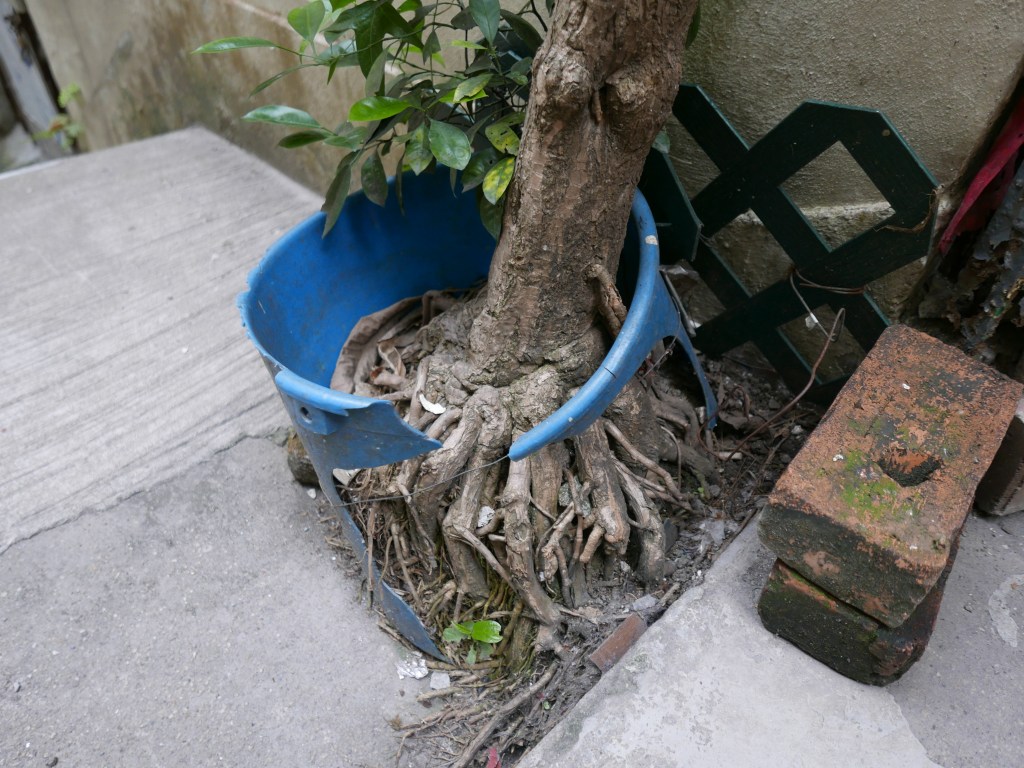
Image: “Hong Kong”, Astrid Møller-Olsen. An image of a tree planted in a blue pot with the roots bursting out of the pot.

In my project “Green Ink,” I am inspired by the monster as a figure that devours the organised realm of definable concepts and boundaries and excretes a fragmented, yet strangely interlinked, world view. I combine theories of the monstrous with critical plants studies’ insistence on the vegetal perspective in an impossible, but productive, attempt to bypass the patterns of prejudice inherent in the human mind.

I examine human-vegetal interactions and interrelationships, dissect plant-like humans and humanoid plants, as well as explore the completely new fictional species that populate contemporary Sinophone writing. Such monsters are rooted in both local and global traditions, they participate in a variety of discourses from genre fiction to ecocriticism, and they disrupt and outgrow every tradition, discourse, and genre they inhabit.

In the study of literature, plants have traditionally been categorised as either poetic metaphors or providers of exotic or romantic backdrops for narrative action. Although this strictly aesthetic perspective may have been adequate in the past, the contemporary global changes to the environment  –and the consequent renewed literary interest in botanical and natural structure and modes of being- –demand a more nuanced and theoretically informed approach. Fortunately, such work is emerging from a variety of different disciplinary perspectives such as critical plant studies, monster theory, feminist posthumanism, and science fiction studies.

In 2013, a group of American literary scholars published the pioneering anthology Literary Plant Studies introducing Rodopi’s Critical Plant Studies Series, the aim of which was to “initiate an interdisciplinary dialogue, whereby philosophy and literature would learn from each other to think about, imagine, and describe, vegetal life with critical awareness, conceptual rigor, and ethical sensitivity” (Marder). The volume, edited by Randy Laist, first cast the green light on plant characters and plant narrators in (primarily Anglophone) literature from Jane Austen’s Mansfield Park over Leslie Marmon Silko’s Ceremony to Alan Moore’s Swamp Thing. In 2017, The Language of Plants edited by Monica Gagliano, John C. Ryan and Patrícia Vieira further explored “a biocentric form of literary criticism” that would “seriously regard the lives of plants in relation to humankind in terms that would look beyond the purely symbolic or ‘correlative’ dimension of the vegetal” (xii) from an interdisciplinary angle, and in 2020 Natania Meeker and Antónia Szabari published their joint monograph Radical Botany, adding a Franco-American perspective to the discussion.

Parallel with these endeavours in botanical literary criticism and philosophy, the study of botanical monsters in horror fiction constitutes another important strand in the project of critical engagement with literary plants. In this growing subfield, researchers find that horror plants naturally tick many of the monstrous boxes described by Jeffrey J. Cohen in his influential text “Monster Culture (Seven Theses)” from 1996. Horror plants seek Frankensteinian revenge for the ill we have done their home planet, they portray deviant sexualities, indulging in excessive auto- or multi-partner reproduction, and they inhabit the limits of knowing as their way of perceiving the world will always illude us despite the best efforts of critical plants studies.

Monster plants fracture the logic of human mastery over nature and expose the Anthropocene as an “epistemological crime-scene stained with erasures of plant consciousness” (Bishop 2018, 7). By blending vegetal, human, and animal characteristics, they force us to abandon the hierarchy of the Great Chain of Being that situates plants at the bottom of a ladder that rises through various “lesser” animals to human beings at the top (Miller 2012, 466). As a subgenre, plant horror “marks humans’ dread of the ‘wildness’ of vegetal nature – its untameability, its pointless excess, its uncontrollable growth,” and function as an unwelcome memento mori reminding us that “while humans may occasionally become food for predatory animals, we all, whether buried in the ground or scattered on the earth, become sustenance for plants” (Keetley 2016, 1).

Inspired and informed by this corpus of literary plant research, my project looks at vegetal-anthropomorph characters that have come out of the closet of horror as a genre and as a type. Such characters can still usefully be approaches as monsters because, even without the horror, they retain an ability to complicate preconceptions and probe what it means to be human, to be plant, or just to be. Some of my monsters are still vengeful, on behalf of the planet or against the imperialism of taxonomy. Some are benevolent, seeking to reintegrate humankind into the natural world we believe to have abandoned. Some are just beings, going about their business, nurturing plants, and falling in love with humans, or the other way round.

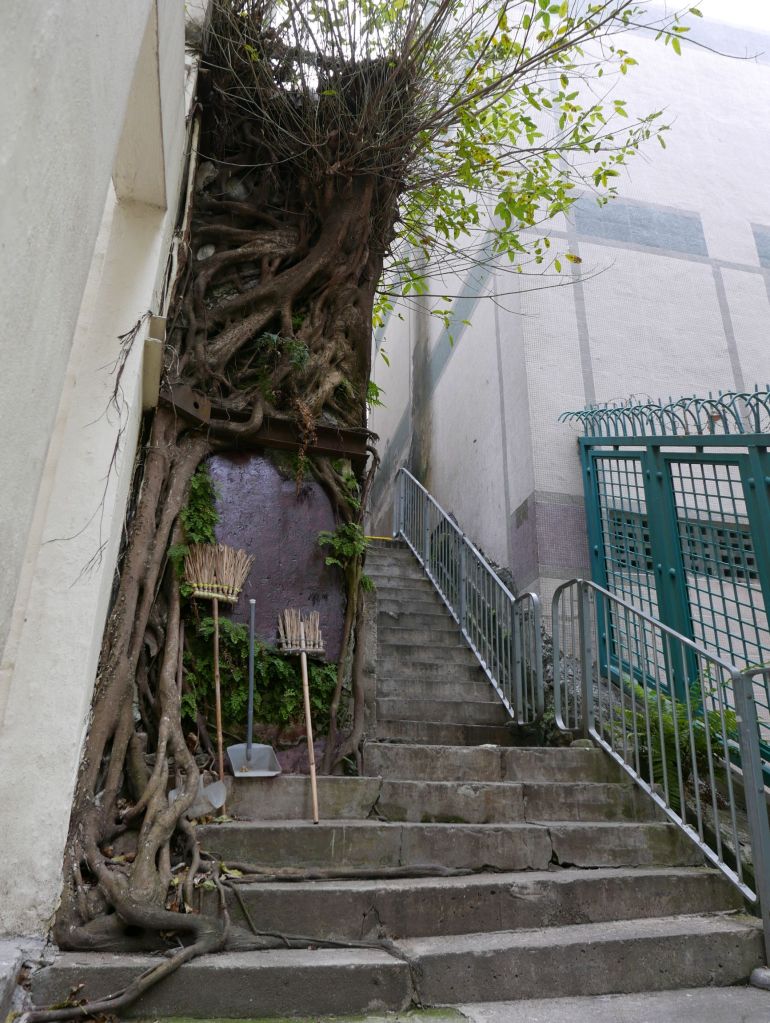
Image: “Hong Kong”, Astrid Møller-Olsen. The image depicts a huge plant growing on/in the wall of a building, with huge roots stretching down the stairs below the building.

Bio

Astrid Møller-Olsen is international postdoctoral research fellow at Lund University (Sweden) posted at University of Stavanger (Norway) and the University of Oxford (UK), in a position funded by the Swedish Research Council. She has a background in both comparative literature and Chinese studies and has published on fictional dictionaries, urban forms of narrative memory, and sensory approaches to the study of literature. Her current research is a cross-generic study of plant-human relationships in contemporary Sinophone literature from science fiction to surrealism.

https://www.sol.lu.se/en/person/AstridMollerOlsen

https://xiaoshuo.blog/

Check out also her podcast series on Sinophone fiction.

Works cited

Bishop, Katherine E. (2018). “’When ‘tis Night, Death is Green’: Vegetal Time in Nineteenth-Century Econoir.” Green Letters 22, no. 1: 7-19. DOI: 10.1080/14688417.2017.1413990

Cohen, Jeffrey J. (1996). “Monster Culture (Seven Theses).” Monster Theory: Reading Culture. Minneapolis: University of Minnesota Press.

Gagliano, Monica; John C. Ryan; Patrícia Vieira (2017). “Introduction.” The Language of Plants: Science, Philosophy, Literature. Minneapolis: University of Minnesota Press.

Laist, Randy (2013). “Introduction.” Plants and Literature: Essays in Critical Plant Studies. Amsterdam: Rodopi.

Marder, Michael (n/d). “Critical Plant Studies.” Brill.com, https://brill.com/view/serial/CPST. Accessed 9 Aug. 2019.

Meeker, Natania and Antónia Szabari (2020). Radical Botany: Plants and Speculative Fiction. New York: Fordham University Press.

Miller, T.S. (2012). “Lives of the Monster Plants: The Revenge of the Vegetable in the Age of Animal Studies.” Journal of the Fantastic in the Arts 23, no.3: 460–479.

Keetley, Dawn (2016). “Introduction: Six Theses on Plant Horror; or, Why Are Plants Horrifying?” Plant Horror: Approaches to the Monstrous Vegetal in Fiction and Film, edited by Dawn Keetley and Angela Tenga. New York: Palgrave MacMillan.