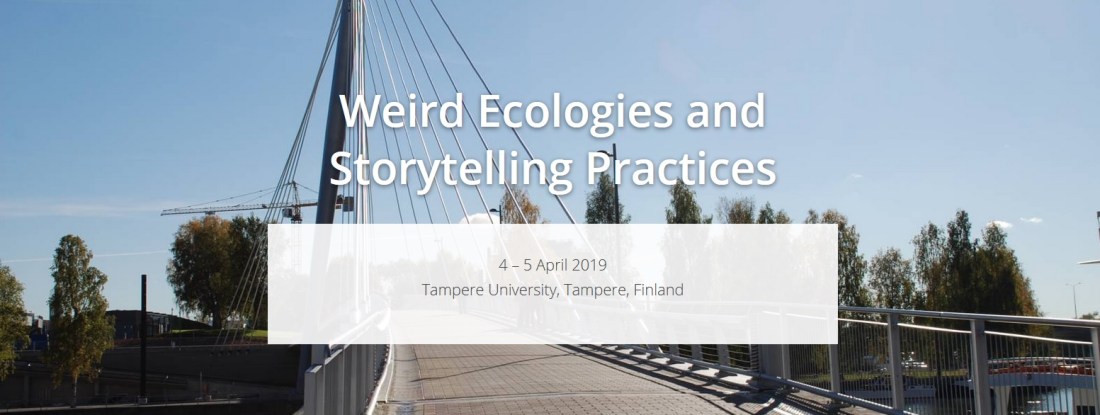
April is fast approaching, and so is the Weird Ecologies and Storytelling Practices workshop! You can keep up to date with the event on its own website or follow it on Facebook like the monster-stalker we know you are!
The seminar explores the ethics and politics of storytelling, especially in regards to telling stories about nature and ‘the Other’. Issues addressed are, for example, how we may think critically about shifting biotechnological landscapes, environmental change and the very notion of “nature” as specific, but also potentially changing, storytelling practices.
Contributors to the seminar are scholars and artists working with questions of embodiment, vulnerability, human–non-human relations, eco-criticism, activism, and embodied storytelling practices. We invite participants to engage directly with academic and artistic practices in order to explore ways in which to imagine livable presents/futures in the midst of cultural anxieties concerning human extinction and the end of the world.
Confirmed speakers: The Monster Network, author Johanna Sinisalo, Dr. Toni Lahtinen (University of Tampere), and author Laura Gustafsson.
Writing workshop with Professor Emerita Nina Lykke.
The seminar is free of charge (dinner, lunches and coffees are free for registered participants and invited guests). The language of the event is English.
Organised by the Monster Network and the project ‘Environmental Risks, Dystopias and Myths in Contemporary Literature’. In collaboration with The Ecocritical Network for Scandinavian Studies (ENSCAN). Funded by Nordic Culture Point.
Find the preliminary programme and register on the event’s website.

In 2018, we have seen worldwide celebrations Mary Shelley’s Frankenstein, where the monster in many ways has become a symbol for the monstrous, the unwanted and the not-quite human. However, Christian Beyer from Tromsø, the Arctic University of Norway, Dr. Line Henriksen from the University of Copenhagen and Dr. Siv Frøydis Berg from the Norwegian National Library have all embraced the monster as an important and highly relevant figure to keep thinking with. What is it about the monster that continues to draw our attention?
(For the transcript, see the information below.)
Monster Talks is a podcast series that explores the figure of the monster and the concept of the monstrous as important thinking tools for addressing dynamics of power, inclusion and exclusion, discrimination and violence. The podcast is made possible by the support of Nordic Culture Point and produced by The Monster Network in collaboration with Network for Gender Studies at UiS.
All episodes and their transcripts are available from the podcast’s website at UiS.

Haunted Humanity: Workshop by The Monster Network
Thursday November 29 – Friday November 30 at Stavanger Kunsthall and The University of Stavanger (UiS)
In light of so-called migratory challenges and increasing nationalism in the Nordic countries, this workshop critically engages with ongoing debates about exclusion and inclusion through the ideas surrounding monsters, ghosts and haunting. The workshop explores not only important historical contexts for how monsters emerged as justifications for discrimination and violence, but also the monstrous Others as figures that haunt the foundations of the very idea of humanity, and what it means to be human today.
The workshop is supported by the Nordic Culture point and is free of charge. Continue reading “Final programme: Haunted Humanity”
Haunted Humanity: Workshop by The Monster Network
Thursday November 29 – Friday November 30 at Stavanger Kunsthall and The University of Stavanger (UiS)
In light of so-called migratory challenges and increasing nationalism in the Nordic countries, this workshop critically engages with ongoing debates about exclusion and inclusion through the ideas surrounding monsters, ghosts and haunting. The workshop explores not only important historical contexts for how monsters emerged as justifications for discrimination and violence, but also the monstrous Others as figures that haunt the foundations of the very idea of humanity, and what it means to be human today.
To participate, email ingvil.f.hellstrand@uis.no before November 7st. The workshop is supported by the Nordic Culture point and is free of charge.
 The Monster Network