Monster Talks transcribed – and a Halloween treat!

In the recent years, The Monster Network has taken up measures to make our activities more accessible. We are therefore happy to let you know that all of our Monster Talks podcasts are now transcribed! The transcriptions can be found here.

And that’s not all! As you might now, The Monster Network has a tradition of hosting/publishing a Halloween special, and there might be something special coming your way this Halloween, too. Stay tuned!

Monsters of the Anthropocene Spring Event on the 27th!

Don’t forget to register for our Monsters of the Anthropocene Spring Event!

Image credit: We are grateful to Tove Kjellmark for letting us use her artwork as part of the Monsters of the Anthropocene Collaboratory. The image is called ‘non-humans only’ (2011). Find out more about Tove Kjellmark’s work here

The Monsters of the Anthropocene collaboratory invites you all to our final event, where we gather a panel of artists and scholars to explore imaginaries of the Anthropocene, with a particular focus on othering, vulnerability and marginalization in our times. Which possibilities do the increased attention to human-nonhuman relationships in the Anthropocene offer for thinking and living with the monster? How can a range of non-human companions, like monsters, robots, animals, and land teach humans something about co-dependencies and shifting positionalities?

Our panel consists of artist Tove Kjellmark (S), Senior Lecturer Ildikó Limpár (Pázmány Péter Catholic University, Budapest, HU) and Professor Neel Ahuja (University of California, Santa Cruz, US). Kjellmark’s recent work The Robot, the Horse and the Immeasurable explores the connections between bodies, movement and agency. Limpár has worked extensively on the monster in her research, with her monograph The Truths of Monsters: Coming of Age with Fantastic Media (2021) addressing themes of climate crisis and science fiction. Ahuja’s work tackles the interstices between imperial expansion, human-animal relationships, and warfare, amongst other themes.

The Monsters of the Anthropocene is a collaboratory between the Monster Network and the Oslo School of Environmental Humanities (OSEH). Its aim is to negotiate the role of the monster as part of the ongoing decentring of the human and exploration of vulnerability and inclusion in feminist, posthumanist, critical disability and decolonial studies, and in environmental humanities. 

Read more on the event here!

Monsters of the Anthropocene

We are happy to introduce the final event of the Monsters of the Anthropocene collaboratory!

Time and place: Apr. 27, 2023 2:00 PM–3:30 PM CET, Zoom

A glass case on a metal trolley. The class case is filled with toy animals whose fur has been removed. A thick line of cords is connected to the glass case, and there is a painting of a small child hanging on the white wall next to the glass case. There is a window directly behind the glass case.

Image credit: We are grateful to Tove Kjellmark for letting us use her artwork as part of the Monsters of the Anthropocene Collaboratory. The image is called ‘non-humans only’ (2011). Find out more about Tove Kjellmark’s work here

About the event

Over the past two decades, ‘the Anthropocene’ has emerged as a term to describe the geological epoch in which we live (as was its original terminological provenance), but also as a tool for a wider understanding of how human activity is shaping all aspects of our world. What kind of monsters populate the Anthropocene, and how can they be good to think and live with in this era of uncertain futures and rapid ecological change? The Monsters of the Anthropocene collaboratory invites to our final event, where we gather a panel of artists and scholars to explore imaginaries of the Anthropocene, with a particular focus on othering, vulnerability and marginalization in our times. Which possibilities do the increased attention to human-nonhuman relationships in the Anthropocene offer for thinking and living with the monster? How can a range of non-human companions, like monsters, robots, animals, and land teach humans something about co-dependencies and shifting positionalities?

Our panel consists of artist Tove Kjellmark (S), Senior Lecturer Ildikó Limpár (Pázmány Péter Catholic University, Budapest, HU) and Professor Neel Ahuja (University of California, Santa Cruz, US). Kjellmark’s recent work The Robot, the Horse and the Immeasurable explores the connections between bodies, movement and agency. Limpár has worked extensively on the monster in her research, with her monograph The Truths of Monsters: Coming of Age with Fantastic Media (2021) addressing themes of climate crisis and science fiction. Ahuja’s work tackles the interstices between imperial expansion, human-animal relationships, and warfare, amongst other themes. The moderator will be Sara E. S. Orning (N).

The Monsters of the Anthropocene is a collaboratory between the Monster Network and the Oslo School of Environmental Humanities (OSEH). Its aim is to negotiate the role of the monster as part of the ongoing decentring of the human and exploration of vulnerability and inclusion in feminist, posthumanist, critical disability and decolonial studies, and in environmental humanities. 

Accessibility

This is an online Zoom webinar that will be recorded. The event will be live-captioned by Zoom and a transcript will be made available afterwards. 

Format

In the webinar mode, only the panel participants and the moderator will be visible. The audience can engage with the event through posting questions in the Q&A box, and by commenting and discussing as the event unfolds in the concurrent Discord channel made available to everyone. 

Participation is free, but you must register to receive the Zoom link. 

About the speakers

An image Tove Kjellmark touching a white sculpture.

Tove Kjellmark was born 1977 and is based in Stockholm, Sweden. She is educated at École des beaux arts and The Royal Institute of Art in Stockholm, where she received her M.F.A. 2009. Kjellmark is initially trained as a sculptor. Besides working in her studio she teaches, mentors and collaborates with humans and non-humans of various types and technologies.

Tove Kjellmak’s work can be described as visual appropriations of forms and structures from the complex world in which we live. She is currently looking at the glitches in transformations between the digital and the organic; the gaps in the experience when moving from one world to another. Tove Kjellmark is recognized for creating spaces of critical reflection about techno-scientific acceleration, artworks that asks questions about the nature of human and nonhuman agency in a highly ‘indoctrinated’ post-human world. Over a longer period of time she dealt with techno-animalism, giving rise to another type of animality, another type of nature but above all very delicately playing the affects of the involved audience.

An image Ildikó Limpár leaning against a copy of Neil Gaiman’s Sandman.

Ildikó Limpár is a Senior Lecturer at Pázmány Péter Catholic University, Budapest (Hungary). She teaches and researches contemporary literature and film with a special focus on fantasy and monster narratives, actively publishing in this academic field both in English and in Hungarian. Her monograph The Truths of Monsters: Coming of Age with Fantastic Media (McFarland, 2021) discusses the use of monsters as literary tools addressing life challenges in contemporary coming-of-age fantasy and science fiction, including challenges that are posed by a rapidly and terrifyingly changing ecosystem. The monsters she has found most intriguing are the undead ones and those who specifically link to the idea of death (and/or possible rebirth), and as part of her research, she aims to explore the relevance of these monsters in fictions of the Anthropocene. She is editor of Displacing the Anxieties of Our World: Spaces of the Imagination (Cambridge Scholars Publishing, 2017), a Hungarian anthology of pop science essays in Monster Studies, focusing on types of monsters in contemporary popular culture (Athenaeum, 2021) and is presently editing a Hungarian anthology on monstrous spaces in contemporary fantastic narratives (forthcoming in 2022 summer). She also writes and translates fiction with monsters; among others, she is the Hungarian translator of Neil Gaiman’s cultic Sandman graphic novel series.

An image of Neel Ahuja outside in a green park.

Neel Ahuja is Professor of Feminist Studies and a core faculty member of the Critical Race and Ethnic Studies Program at the University of California – Santa Cruz. Neel’s research explores the relationship of the body to the geopolitical, environmental, and public health contexts of colonial governance, warfare, and security. Neel is the author of two books, Bioinsecurities: Disease Interventions, Empire, and the Government of Species (2016) and Planetary Specters: Race, Migration, and Climate Change in the Twenty-First Century (2021). He has written a variety of essays on the connections of race and colonialism to the fields of disability studies and animal studies. He is currently working on two research areas, one exploring the race and species politics of COVID-19 and another analyzing United States counterterrorism incarceration, rendition, and interrogation practices.

Think/Feel/Repeat: Writing-with the Memory Space Traveler

what do machines dream of
if not electric sheep
a remembrance
in the shape of
a butterfly, a tree
neurons turning
into trees
trees into waves
so many
waves
whales
singing
a mirage
medusas into mountain tops
into a Japanese painting
of waves
such waves
into neurons
neurons into
a mirage
a
a
a
bird, swan, cloud
a nebula
a universe
a verse
a
a
a
lightning strike
so bright
a network
I remember
the hurt
but this is not how it went
at all
waves into
neurons into
spider webs into
a haunted house into
a sunken ship
a treasure
a moth
a
a
a
ripple
of snow
mist forest fungi
lungs breathing broken
glass
a fragment
a mirage
a flicker
a
a
a
neuron
a star
a bone
a forest
with roots
of smoke
a nebula
a stream
birds like sparkly
space-things
butterflies
of the eternal
a swan
an angel
an alien
a universe, a verse
this is how I remember
a mirage
in mid-july
a
a
a
medusa
a ghost
a compost
mushrooms
pushing up from the ground
life
stubborn
life
remembered, forgotten
ancient, anew
but this is not how
it is going to
a glitch in the machine
a ghost ship
a tipping point
in time
be remembered
a mirage
a shape-shifter
a
a
a
does it matter
what is real
we are all
sleepwalkers
through time
you
and
i
monsters
in mid-july

.

.

.

Outro

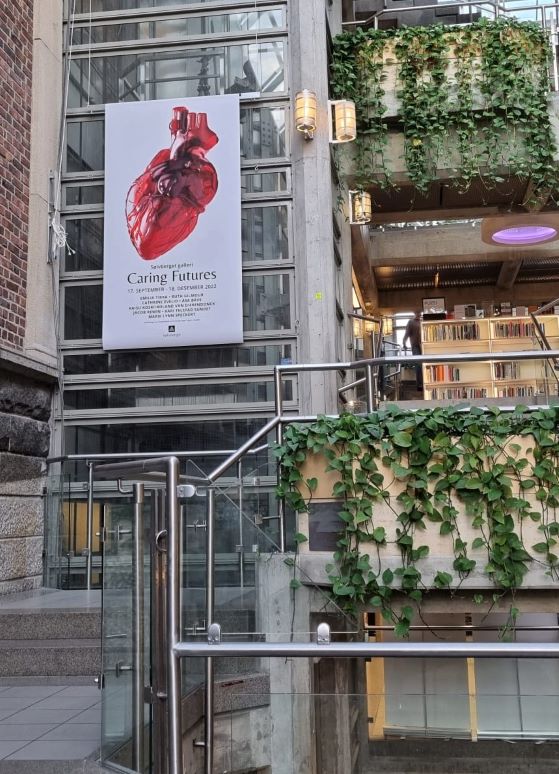
In November and December 2022, I spent some time as a visiting scholar at the University of Stavanger (UiS), Norway, where I worked in the project Caring Futures: Developing Care Ethics for Technology-Mediated Care Practices. As part of my work, I got to experience the Caring Futures art exhibition, that is connected to the research project, at Sølvberget galleri, Stavanger, Norway.

Image: The stairways leading to the exhibition space at Sølvberget galleri. There is a poster of the exhibition showcasing a red, artificial heart, and green wines hanging in the staircase. Photo taken by Aino-Kaisa Koistinen.

The Caring Futures exhibition asks questions such as ”what is at stake when technological innovations are presented as solutions to new demands in contemporary care and welfare. Are questions about ethics, trust, and compassion left behind in the rapid development and implementation of new technologies?” Read more here.

The exhibition is put together by Monster Network’s Ingvil Hellstrand, Associate Professor at the Department of Caring and Ethics, UiS, who currently works in the Caring Futures project, and artist/curator/PhD-candidate Hege Tapio, who runs i/o/lab: Centre for Future Art and works at OsloMet.

For me, exhibition raised questions of the limits of care, affects, movements and connections, memory, boundaries, and the connections of care and violence. The exhibition is open until 18 December 2022 – so there is still time to experience the exhibition for yourself! I fell in love especially with Kari Telstad Sundet’s audiovisual installation ”Memory Space Traveler”, a work that, according to the exhibition catalogue, ”tries to look at mechanomorphism and anthropomorphism from a different angle – literally through the dreams of a semi-sentient machine”.

The above text – a poem, a seance, a meditation? – is a slightly edited stream of consciousness written while thinking- and feeling-with the video installation. The typography of the text was created partly as a surprise; a glitch in WordPress that removed all the empty lines from the text. This glitch perhaps made the text more true to the process of its creation, a stream of consciousness moving with the video installation, ideas and associations constantly changing and evolving.

Aino-Kaisa Koistinen

New episode of Monster Talks: Halloween Special!

Image: The Monster Talks logo (Artwork by Joanne Teresa Taylor, NettOp, University of Stavanger).

In this Halloween-episode of Monster Talks, we talk about fiction writer Becky Chambers’ novel The Galaxy and the Ground Within (2021) This is a rich novel that brings out questions of colonialism, power and vulnerability through a chance meeting of three travelers from various species on a transport hub in the galaxy. Chambers weaves their different stories through how they listen (or not) to each other, and through how they pay attention to (or not) the small details of everyday life and survival for each one of them.

Dr. Donna McCormack (Strathclyde University, Scotland) and Dr. Ingvil Hellstrand (University of Stavanger, Norway) from the Monster Network excitedly share their thoughts about the novel and what we can learn from its negotiations of normativity, accessibility and power dynamics. 

There is a downloadable transcript for the podcast that can be accessed here.

Monster Talks is a podcast series that explores the figure of the monster and the concept of the monstrous as important thinking tools for addressing dynamics of power, inclusion and exclusion, discrimination and violence. The podcast is produced by The Monster Network in collaboration with Network for Gender Studies at UiS.

All episodes and their transcripts are available from the podcast’s website at UiS.

Artwork by Joanne Teresa Taylor, NettOp, University of Stavanger.