Our podcast Monster Talks now has it’s very own logo! The fantastic artwork is by Joanne Teresa Taylor from NettOp at the University of Stavanger.
Monster Talks explores topical issues such as the end of the world, monster methods and weird ecologies, so do take a listen! It promises to return the favour.
What does it mean for the world to end? Does it end in the same way for all? And might it have already ended for some? During the summer and autumn of 2019 the art collective SUPERFLEX flooded Cisternerne, an exhibition space for contemporary art in the abandoned underground water reservoirs of Copenhagen, and invited visitors into a dark, post-apocalyptic world. The title of the exhibition was It’s not the End of the World, and in this podcast-episode Line Henriksen from the Monster Network met with independent artist Katja Aglert, PhD candidate Ida Hillerup Hansen and postdoctoral researcher Marietta Radomska in the cold dark depths of Copenhagen to discuss the (non)ending of the world.
About the researchers and artists of this episode:
Katja Aglert is an independent artist whose practice is transdisciplinary in nature, and includes both individual and collaborative projects. She is an executive board member of The Seed Box, an international environmental humanities collaboratory headquartered at Linköping University. She teaches regularly at Umeå Art Academy, and Konstfack University of Arts, Crafts, and Design.
Ida Hillerup Hansen is a PhD candidate at the Department of Gender Studies at Central European University in Budapest and currently a visiting researcher at Institute for Cultural Inquiry at Utrecht University. Their research explores embodied experience of loss through a lens of contemporary grief discourse and feminist poststructuralist and psychoanalytic theories of mourning.
Marietta Radomska, PhD, is a Postdoc at the Department of Thematic Studies, Linköping University, and Department of Cultures, University of Helsinki. Her current research focuses on ecologies of death in the context of contemporary art. She is the author of the monograph Uncontainable Life: A Biophilosophy of Bioart (2016), and has published in Australian Feminist Studies, Somatechnics, Angelaki, and Women, Gender & Research, among others. Queer Death Studies Network website: https://queerdeathstudies.net/ |The Posthumanities Hub website: https://posthumanities.net/
(For the transcript, see the information below.)
Monster Talks is a podcast series that explores the figure of the monster and the concept of the monstrous as important thinking tools for addressing dynamics of power, inclusion and exclusion, discrimination and violence. The podcast is made possible by the support of Nordic Culture Point and produced by The Monster Network in collaboration with Network for Gender Studies at UiS.
Making writing monsters is easier than you think, and an ideal family activity to have fun with over the holiday break. Living with them is another story (this might be a life-long ethical exercise in living with something that you do not fully control). Follow these easy recipes and have your own monsters ready in a fraction of the time it takes to order them online:
1
Collage Monster
Image description: Table filled with paper, writing utensils and mugs. You can see the hands of the people sitting around the table, holding pens and papers. Photo by Marie Blønd for ETHOS Lab.
You will need:
For 1 collage monster:
Pen
Paper
A text
Hope
Scissors
Vulnerability
Tears
Agony
Glue
Colleagues (can be substituted by friends, family, total strangers, or 7 dogs)
A time-keeper with a timer
Aim:
To recreate your own text using other people’s sentences.
Method:
Cut sentences from your text. If you have 9 colleagues, you’ll need 9 sentences. If you have 5 total strangers, you will need 5 sentences. If you have 7 dogs, you will need around 133 sentences and the ability to work with chewed up material. Important: you do not need to use all your text! When you have the sentences you need, put the remaining text aside.
Round one:
Share a sentence with one of your colleagues. Choose something that you think they’ll like.
Receive one sentence from one of your colleagues.
Take 5 minutes to glue the sentence you receive onto a piece of paper. You can modify it in any way you want: delete or rearrange words, add words with your pen, write a new sentence using the words you were given, etc. Just keep in mind: you are still trying to write about the subject of your old text.
The time-keeper will let you know when the time is up.
Round two:
Share a sentence with one of your colleagues (not the same as before). Choose something that you think they’ll like.
Receive one sentence from one of your colleagues (not the same as before).
Take 10 minutes to glue the sentence you receive onto your paper. You can modify it in any way you want: delete or rearrange words, add words with your pen, write a new sentence using the words you were given, etc. Keep in mind: you are still trying to write about the subject of your old text.
The time-keeper will let you know when the time is up.
Repeat the rounds until everybody have received a sentence from everybody else.
Final round: take 10 – 20 minutes to reorganize and polish your text in any way you please. Add sentences, glitter or/and drawings. Keep in mind: you are still trying to write about the subject of your old text. The time-keeper will let you know when the time is up.
Finished! You have now created your very own collage monster in no time, with very little effort, and eternal damnation to follow. Bask in your own accomplishments with lightning, a good thunderstorm and some hubris before the consequences catch you unawares.
2
hello text
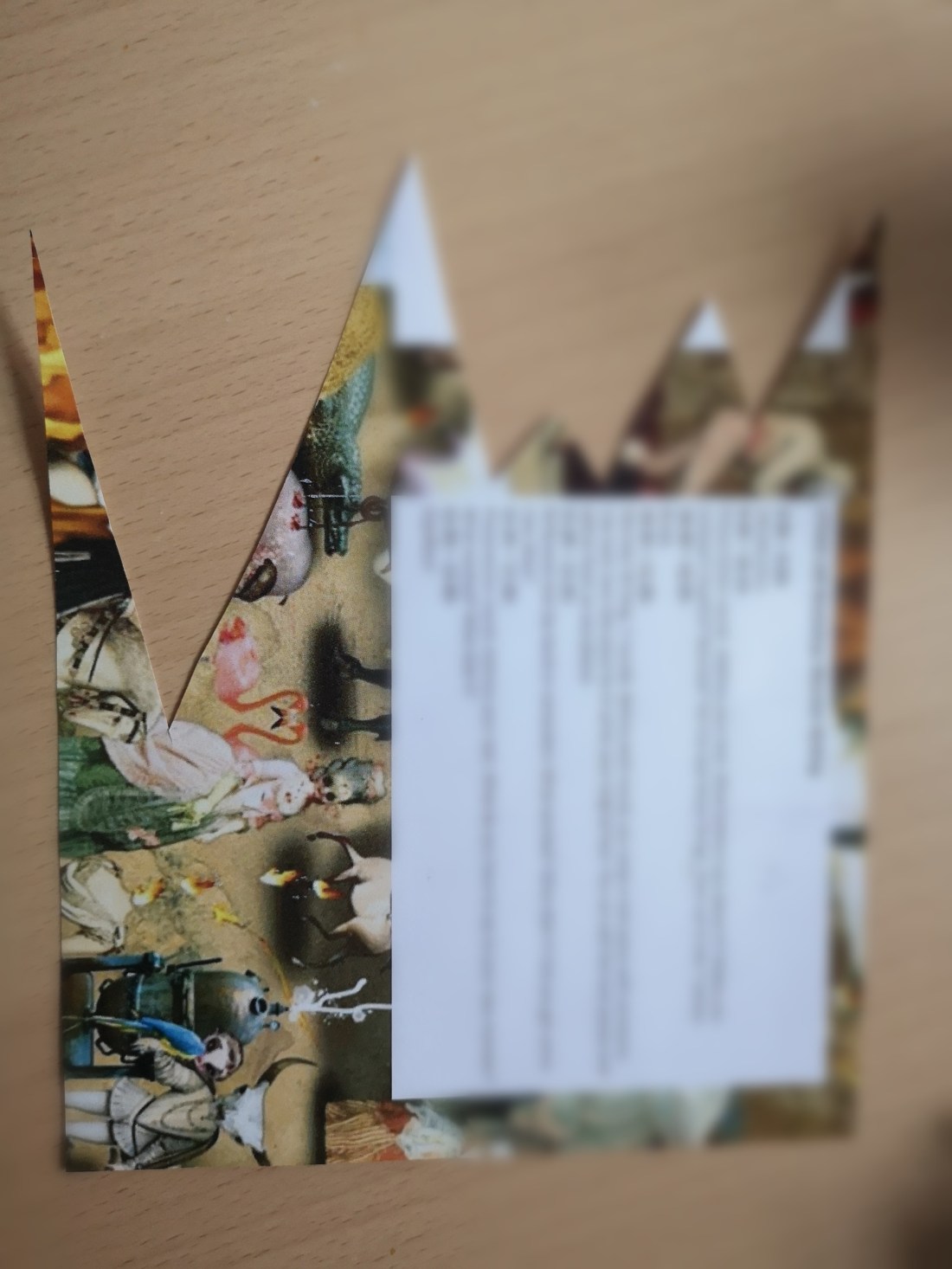
Image description: piece of white paper with blurred writing atop a cut-out, jagged piece of paper depicting a colourful scene with various Hieronimus Bosch-looking monsters. Photo by Marie Blønd for ETHOS Lab. Artwork by Mia Makila.
Image description: scraps of paper with text on lined up on a dark grey table. The “heading” on a piece of paper says “WRITING MONSTERS”.
Hello text
I don’t know if you want to be written
What might it mean to think of writing as monstrous? Or the act of writing as the act of creating a monster? Like the weird scientist in the lab. Like Frankenstein chasing his creation across the Arctic after rejecting it.
Hello text
I am not sure I like you
In the workshop ‘Monster Writing’, which was held in November 2019 at ETHOSLab, the IT University of Copenhagen, we explored text as something somewhat monstrous. Drawing on Nina Lykke’s exorcise of ‘writing the posthuman’ – in which she suggests that the writer addresses the object of their writing as a ‘you’ directly in the text – we wanted to experiment with what it might be like to address the text itself in this way, as a you, but out loud. A summoning. We therefore asked the participants of the workshop to bring a text that they were somehow not completely happy with. In the invitation we wrote:






 The Monster Network