Monster Writing Month 2

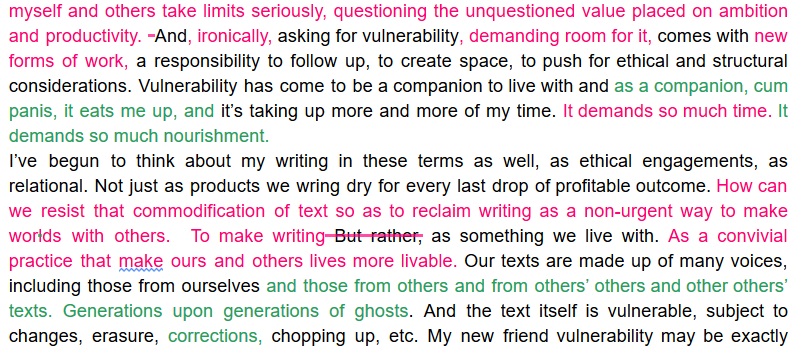
This blog post springs from and reflects on the Monster Writing workshop at ETHOS Lab, IT University of Copenhagen, November 2019. It is written by using and not accepting track changes. For other examples of multiple voices as monster methods, listen to the Monster Talks podcast episode Collective voices and the materialisation of ideas – monster as methods, or read the introduction to the Monster Network special issue of Somatechnics Journal, Promises, Monsters and Methodologies: the Ethics, Politics and Poetics of the Monstrous

Tracked Changes Vulnerabilities: Reflections on writing with monsters

By Marisa Cohn, Katrine Meldgaard Kjær and Line Henriksen

1 Track Changes2 Track Changes3 Track Changes4 Track Changes5 Track Changes

Monster Writing Month 1

Writing Monsters

by Katrine Meldgaard Kjær and Line Henriksen

Image
Image description: scraps of paper with text on lined up on a dark grey table. The “heading” on a piece of paper says “WRITING MONSTERS”.

Hello text

I don’t know if you want to be written

What might it mean to think of writing as monstrous? Or the act of writing as the act of creating a monster? Like the weird scientist in the lab. Like Frankenstein chasing his creation across the Arctic after rejecting it.

Hello text

I am not sure I like you

In the workshop ‘Monster Writing’, which was held in November 2019 at ETHOSLab, the IT University of Copenhagen, we explored text as something somewhat monstrous. Drawing on Nina Lykke’s exorcise of ‘writing the posthuman’ – in which she suggests that the writer addresses the object of their writing as a ‘you’ directly in the text – we wanted to experiment with what it might be like to address the text itself in this way, as a you, but out loud. A summoning. We therefore asked the participants of the workshop to bring a text that they were somehow not completely happy with. In the invitation we wrote:

Continue reading “Monster Writing Month 1”

Monstrous architecture

— Guest post from architects Signe Pērkone and Ramón Córdova –

In July of 2019, the Monster Network was invited to give a keynote at the symposium Monstrous Ontologies: Politics, Ethics, Materiality at the University of Roehampton in London (you can listen to our keynote here). One of the presentations at the symposium was delivered by the architects Signe Pērkone and Ramón Córdova, who talked about how they work with the monster in their own architectural practice. We were intrigued and interested by what we heard, and saw a lot of connections to how we think, work, and write with the monster in the Monster Network. So we asked them if they wanted to write a blog post for us!

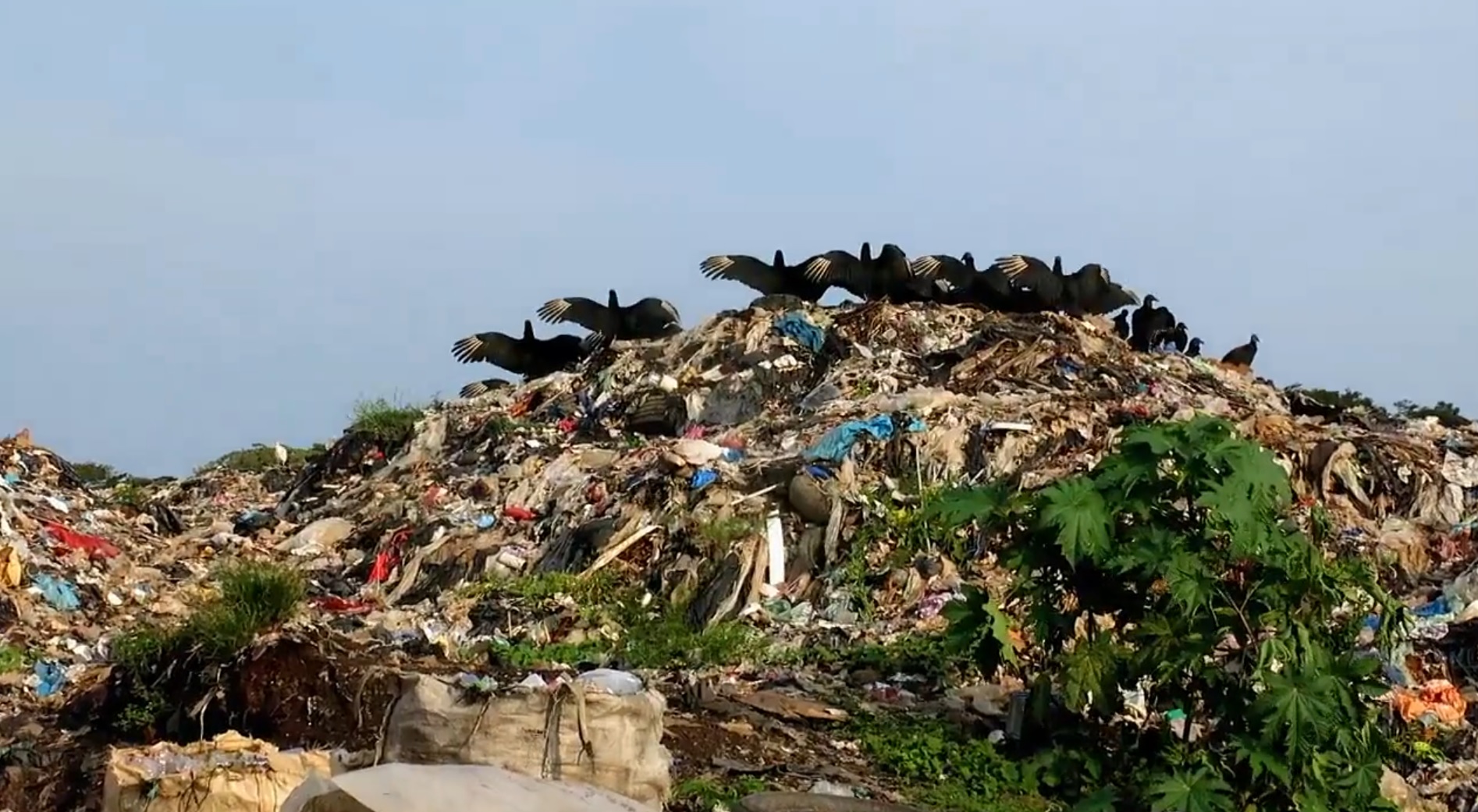
In what follows, Signe and Ramón write about their experience working with, amongst other things, a territory occupied by a vast landfill close to the southern border of Mexico. During their talk they showed a video from the landfill, which can be viewed here (password: Ecologies).

Before giving you a chance to explore architecture and the monster, we let Signe and Ramón introduce themselves:

Signe and Ramón are architects and researchers based in Riga, Latvia. They strive to practice architecture as an integral part of the affective and relational lived experience. They have studied, worked and done research in Europe and Mexico, and their work has been presented in various conferences, art exhibitions and publications. They are interested in expanding their practice by intersecting it with other disciplines, and fostering discussion of its becomings and emergence from territories and assemblages of human and non-human components.

Image
Image description: part of a large, colorful landfill against blue sky. Several large birds, perhaps vultures, are perching atop the hill with their wings outstretched. Image from Signe Pērkone and Ramón Córdova’s video ‘Landfill clips’ (password: Ecologies)

Meeting the Monster Half Way

Monster as a Tool for Enriching Spatial Practices

 There are territories, places and spaces that after establishing relations with certain agents or in particular conditions become monstrous assemblages in the collective imagination, from slums to squatted buildings, and from crime infested city communities to remote landfills inhabited by migrants. But what does this monstering mean for the places themselves? What does it mean for us, who need to interact with them? Even more, those who deal with spatial disciplines, such as architecture, are often called upon to intervene in these territories, to make sense of them, to “improve” them. However, there is a danger in acting before understanding because, in one way or another, this leads to forced conclusions, filling in the gaps in knowledge with assumptions, and normative faux-solutions. Continue reading “Monstrous architecture”

Promises of Monsters


She studies this transformation through maps

European perceptions of human diversity


The first part sketches

the processes through

ambivalent space

for aging femininity  of

possession

of the emphasis on the importance of maps


The child then flew into the Pine Barrens, becoming

an emancipated minor. After all, who can speak

for the monster, and in so doing who may be

silenced, and what facilitates a monstrous challenge or defiance

rather than reductive

dehumanisation?


To turn into waste means to lose worth, significance, or purpose. A later text of Derrida’s can perhaps account for this.


The text is littered with

horror film,

beautiful paintings,              drawings          and photographs,           recognition and acceptance             and       those who do not                  fit

aging,           disability,          and             AD,       books,      and  images,  negative attitudes                monstrous voices and monstrous spaces,  and  both

popular understanding and film.

filled with the poetry of Ursula Le Guin and the storytelling of Donna Haraway.


in          in          in                         in which

a    a    a    a

of  of  of  of


narratives intersect

generate generate generate


her book: a highly original

with on the one hand a, but on the other hand  –


and this integration of different sources

as she states in her introduction

may well be the most and convincing aspect


It is certainly an ambiguous time

It is certainly an ambiguous time

It is certainly an ambiguous time

in shaping  growing  hardening


for the monster

towards –


* This poem is a collage based on the Promises of Monsters special issue (2018, vol. 2, no. 2, edited by The Monster Network), created in an online writing meeting with two of the members of The Monster Network. The material for the collage was chosen with the method of rolling an electronic dice for a) article, b) page, c) sentence. This material (8 sentences) was then edited into a poem; a collective voice, a monster, that emerges from the issue, if you may.

The materials were found from the following texts (listed in random order):

  • E. J. Nielsen’s caption for Figure 20. The Jersey Devil
  • Agnieszka Kotwasińska: “Un/re/production of Old Age in The Taking of Deborah Logan”
  • The Monster Network (Hellstrand et al.): “Promises, Monsters and Methodologies: The Ethics, Politics and Poetics of the Monstrous”
  • Marietta Radomska: “Promises of Non/Living Monsters and Uncontainable Life”
  • Nicola Moffat: “Monstrous Promises: Performative Acts and Corporeality in Mary Shelley’s Frankenstein”
  • Donna McCormack’s review on Arts of Living on a Damaged Planet: Ghosts and Monsters of the Anthropocene (Tsing et al.)
  • “Monster Talk: A Virtual Roundtable with Mark Bould, Liv Bugge, Surekha Davies, Margrit Shildrick and Jeffrey Weinstock” (edited by Donna McCormack)
  • Erling Sandmo’s review on (Surekha Davies) Renaissance Ethnography and the Invention of the Human: New Worlds, Maps and Monsters

Sneak peak into our event “Weird ecologies and storytelling practices”: Video by Gustaffson&Haapoja!


The Monster Network is proud to present the video “Embrace your Empathy!” with the permission of Gustafsson&Haapoja.


“Embrace Your Empathy!” is a work by Gustafsson&Haapoja. It was created for Flow Festival 2016 (Helsinki, Finland) along with a manifesto and flags of Utopian nations, where humans would co-exist more peacefully and equally with other animals. The video is realized by Matti Vesanen and the music composed by Mikko Virmajoki. It was originally shown without the music on repeat on a big screen near the festival entrance.

In her keynote lecture in the Monster Network’s event “Weird Ecologies and Storytelling Practices”, Laura Gustafsson discussed art, advertisement and propaganda, and this video was one of the examples used in her talk. Gustafsson sought to answer, whether it is possible to advertise empathy beyond rhetorics. How to make a person willingly give up their privileges and tune into the same level with other beings without resulting in propaganda?